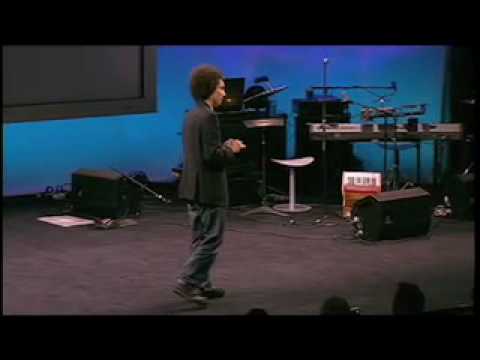
How not to take things personally?
Summary
Frederik starts his talk with a referee's whistle, which makes sense. He recently became a football referee not for the 20 euros a match, but to learn how not to take things personally. It’s a skill he admits he struggles with, whether it’s a driver tailgating him or someone checking their phone while he’s giving a speech.
He frames the problem as a battle with our own ego, which always wants to be right. This sets up his central question: do you want to be right, or do you want to be happy? The answer, he suggests, lies in a strategy as simple as a coin toss.
The first side of the coin is the idea, “It’s not about me.” He argues that most of the time, the person annoying you is just caught up in their own world. The tailgater is in a hurry, the person on their phone might be taking notes. Shifting focus from “me” to “we” defuses the irritation.
But sometimes, that doesn’t work. The insult still stings. That’s the other side of the coin: “It is about me.” This happens when criticism hits a raw nerve, an insecurity, or an old wound. The solution then isn't to brush it off, but to give yourself some empathy and, if needed, speak up about how you feel.
He closes with a brilliant demonstration, crumpling a 20 euro note and asking if anyone still wants it. Of course, they do. Its value is unchanged. The point is clear: people can criticize you, ignore you, and metaphorically crumple you up, but you never lose your value.
Why this talk worked
The hook
Frederik doesn’t walk out and introduce his topic. He blows a referee’s whistle and declares the next 18 minutes a “match.” He immediately casts the audience as a single team, asks a man in the front row to be the captain, and gets everyone on board with the rules of fair play.
This is a smart, disarming move. It bypasses the usual speaker-audience dynamic and creates a shared, playful experience from the first second. The referee framing isn’t just a gimmick, it’s the talk’s central metaphor, and he introduces it through action, not explanation. He has our attention before he’s even stated his premise.
Why it resonates
Everyone takes things personally. The power of Frederik’s talk is that he doesn’t focus on grand betrayals but on the thousand tiny paper cuts of daily life. A driver honks, a friend cancels plans, someone looks at their phone during your story. These are the small, maddening moments that are so common they’re rarely discussed with any real strategy.
He gives this universal feeling a name: the ego. By framing it as our ego wanting to be right versus our desire to be happy, he turns a vague emotional reaction into a clear internal conflict. People see themselves in this immediately because he’s not just describing a feeling, he’s articulating the frustrating, energy-draining internal monologue that goes with it.
How it is built
The talk’s architecture is remarkably clean and held together by the refereeing metaphor. It’s a simple, effective problem and solution structure.
First, Frederik establishes the problem with personal, relatable anecdotes. He feels “hunted” by tailgaters and slighted by distracted audience members. This builds rapport because he’s not an expert lecturing from on high, he’s a fellow struggler.
The turn comes with the coin toss. This is the simple, elegant device that introduces his two-part framework. It’s a physical prop that makes an abstract idea concrete and memorable. The two strategies, “heads” and “tails,” become the two pillars of his argument.
- •Strategy 1: It’s not about me. He explains the first approach, using his refereeing experience as the primary case study. He looks for the other person's intention, shifting focus from his own feelings to their motivation.
- •Strategy 2: It is about me. Crucially, he admits the first strategy isn't foolproof. When an insult really hurts, it’s because it has hooked into a pre-existing insecurity. This adds a necessary layer of psychological depth and self-compassion to the talk. It's not just about managing others, but understanding yourself.
The final demonstration with the 20 euro note is a masterstroke. It’s a surprise twist that elevates the talk from a useful 'how-to' into a profound statement on self-worth. It doesn’t just summarize his points, it gives the audience an unforgettable, visceral image to carry away.
The delivery
Frederik’s style is conversational, warm, and entirely without pretense. He's a man sharing something he's figured out, not a guru dispensing wisdom. His power comes from his vulnerability. He openly admits, “I really struggle with this,” and his little physical mannerisms, like snapping his fingers when he describes taking something personally, feel authentic.
He uses self-deprecation effectively, particularly when describing his own insecurities as a new referee who has never even played soccer. When he says “Ouch!” after listing the insults shouted from the sidelines, you feel it with him. This willingness to look a little foolish makes him incredibly trustworthy.
His interaction with the audience is also key. He gets them to shout insults, asks for a show of hands, and speaks directly to a man in the front row. It all contributes to the feeling of a shared space, a conversation rather than a lecture. There’s a quiet confidence to him, but it’s the confidence of a peer, not a performer.
Why it spreads
This talk is built to travel. It’s packed with simple, sticky ideas that are easy to remember and repeat.
The central reframe, “Do you want to be right or do you want to be happy?”, is a classic for a reason. It’s a powerful, concise question that can be applied to almost any interpersonal conflict.
Frederik’s two-sided coin framework is the core of its shareability. “It’s not about me / It is about me” is a simple, actionable diagnostic tool. It’s the kind of thing you can easily explain to a friend over coffee, providing a genuinely useful way to think through a frustrating situation.
The final image of the crumpled 20 euro note is the talk’s most powerful asset. It’s a story, a visual, and a metaphor all in one. It’s incredibly easy to retell and its meaning is instantly clear: your intrinsic value remains constant, regardless of what people say or do to you. That’s not just a nice idea, it’s a deeply comforting and empowering one that people will want to pass on.
Want your talk to land like this?
We help TEDx speakers get their talks in front of the audience they deserve. A 15-minute call is all it takes.
Book your free 15-min call