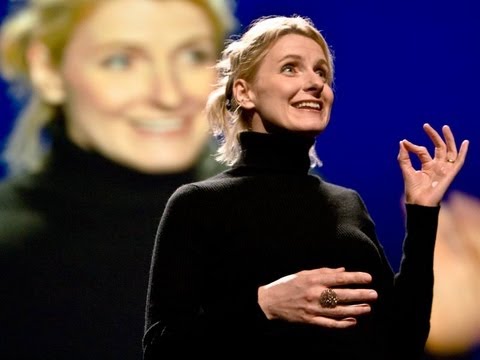
The art of asking
Summary
Amanda Palmer begins with her old job, which she describes with a certain amount of pride. For five years, she was a self-employed living statue called the Eight-Foot Bride, handing out flowers and intense eye contact to anyone who dropped money in her hat.
She learned a lot on that box. She discovered that asking for money wasn't shameful but a form of connection, an exchange where she and a stranger could truly see each other. She also learned it could provide a surprisingly predictable income.
Palmer carried this ethos into her music career with the Dresden Dolls, always staying after shows to sign things, hug fans, and invite local artists to perform with her. When Twitter came along, it amplified her ability to ask for anything, anywhere: a piano to practice on, a home-cooked meal, a place to sleep.
This led to some remarkable encounters, like staying with the family of an undocumented immigrant in Miami who insisted on giving Palmer and her crew their beds. This direct connection stood in stark contrast to her experience with a major record label, which deemed her album a failure for selling only 25,000 copies.
The real turning point came when fans who had pirated her music started handing her cash at shows, wanting to support her directly. Palmer realized her connection with her audience was her true business model.
She ran a Kickstarter campaign aiming for 100,000 dollars and raised nearly 1.2 million from about 25,000 people. The same number the label saw as a failure. Palmer argues the music industry has been asking the wrong question. It should not be “How do we make people pay for music?” but “How do we let them?”
Why this talk worked
The hook
Amanda Palmer doesn't open with a thesis or a statistic. She opens with a photograph of herself looking like a ghostly, silent art installation. Dressed as the "Eight-Foot Bride," she's painted white, standing on a box, utterly still.
The image is strange and arresting. It immediately poses a question: who is this person, and what does this have to do with anything? Palmer lets the question hang for a moment, then answers it with a perfectly timed, disarming, “Hello.” It gets a laugh and instantly establishes her as relatable and slightly absurd, not a self-important rock star.
This move is effective because it grounds her entire argument in a physical, vulnerable, and slightly bizarre personal experience. Before she ever talks about crowdfunding or the music industry, we see her on a box, with a hat at her feet, asking for money one person at a time.
Why it resonates
Most people, and artists in particular, have a complicated relationship with asking for money. It often feels like begging, a sign of failure or neediness. Palmer zeroes in on this discomfort when people would yell “Get a job!” from their cars, making her feel her work was “un-joblike and unfair, shameful.”
This is the core tension of the talk. She gives voice to the quiet fear that asking for help makes you vulnerable and delegitimizes your work. The story of the opening act musician who couldn’t bring himself to pass the hat because it felt wrong is a moment of pure recognition for anyone who has ever hesitated to ask for what they are worth.
Palmer systematically dismantles this shame. She reframes asking not as a transaction, but as an act of trust and connection. By showing that this vulnerability is actually a strength, she offers a powerful new perspective for creatives, freelancers, and anyone trying to build a community around their work. It gives them permission to see asking as a way to build relationships, not just a way to get paid.
How it is built
Palmer structures her talk around a central conflict: the old world of commerce versus the new world of connection. The old world is the major label, a faceless entity that defines success with a single, impersonal metric. For them, 25,000 albums sold is a failure.
The new world is the sidewalk. It is personal, direct, and built on what she calls “prolonged eye contact.” Here, success is measured in small, human exchanges. A flower for a dollar, a bed for the night, a nurse delivering a neti pot to a cafe.
The entire talk builds toward the collision of these two worlds. The turn comes when the label declares her a failure right as a fan hands her a ten-dollar bill for a pirated CD. This is the moment Palmer realizes her direct connection to her audience is more powerful and sustainable than the entire industry apparatus.
The payoff is the Kickstarter result. The fact that her campaign was funded by 25,000 people, the exact number the label used to dismiss her, is a perfect, poetic victory. It proves her thesis in a concrete and undeniable way. The whole argument is carried by the simple metaphor of the hat, which transforms from a physical object on the street to a symbol of her entire career philosophy.
The delivery
Palmer’s style is key to making her argument land. She speaks like she's telling stories to a friend, not delivering a lecture. Her timing is impeccable, using pauses and dry asides to great effect. When she recalls wondering if couchsurfing alone is “how stupid people die,” the self-awareness makes her instantly likeable.
There's a complete lack of polish that works in her favor. She’s not selling a slick formula for success. She’s sharing messy, personal experiences, from sleeping on the floor in punk squats to the awkward intimacy of letting drunk German fans draw on her naked body.
This raw honesty makes her vulnerable, which is precisely what her talk is about. When she admits that the criticism of her crowdsourcing practices “hurt in a really familiar way,” it feels genuine. She doesn't present herself as an untouchable star who has it all figured out. She presents herself as someone who has spent a career learning, through trial and error, how to trust people.
Why it spreads
This talk is endlessly shareable because it offers a single, powerful reframe that changes how people think. The shift from “How do we make people pay?” to “How do we let people pay?” is the kind of idea that fundamentally alters a conversation. It’s simple, elegant, and perfectly captures her entire philosophy.
Her stories are also incredibly sticky. The Eight-Foot Bride is an unforgettable visual. The story of the Honduran family who gave up their beds is a powerful illustration of generosity and connection. These are not abstract points, they are miniature narratives that people can easily remember and retell.
Finally, Palmer provides a lexicon for a new kind of creative economy. Phrases like “the art of asking” and her comparison of couchsurfing to crowdsurfing give people a language to describe the relationship-based models they are already trying to build. The talk spread not because it was a viral hit, but because it armed a generation of creators with a philosophy and a justification for working outside traditional systems. They were the ones who passed it on.
Want your talk to land like this?
We help TEDx speakers get their talks in front of the audience they deserve. A 15-minute call is all it takes.
Book your free 15-min call